

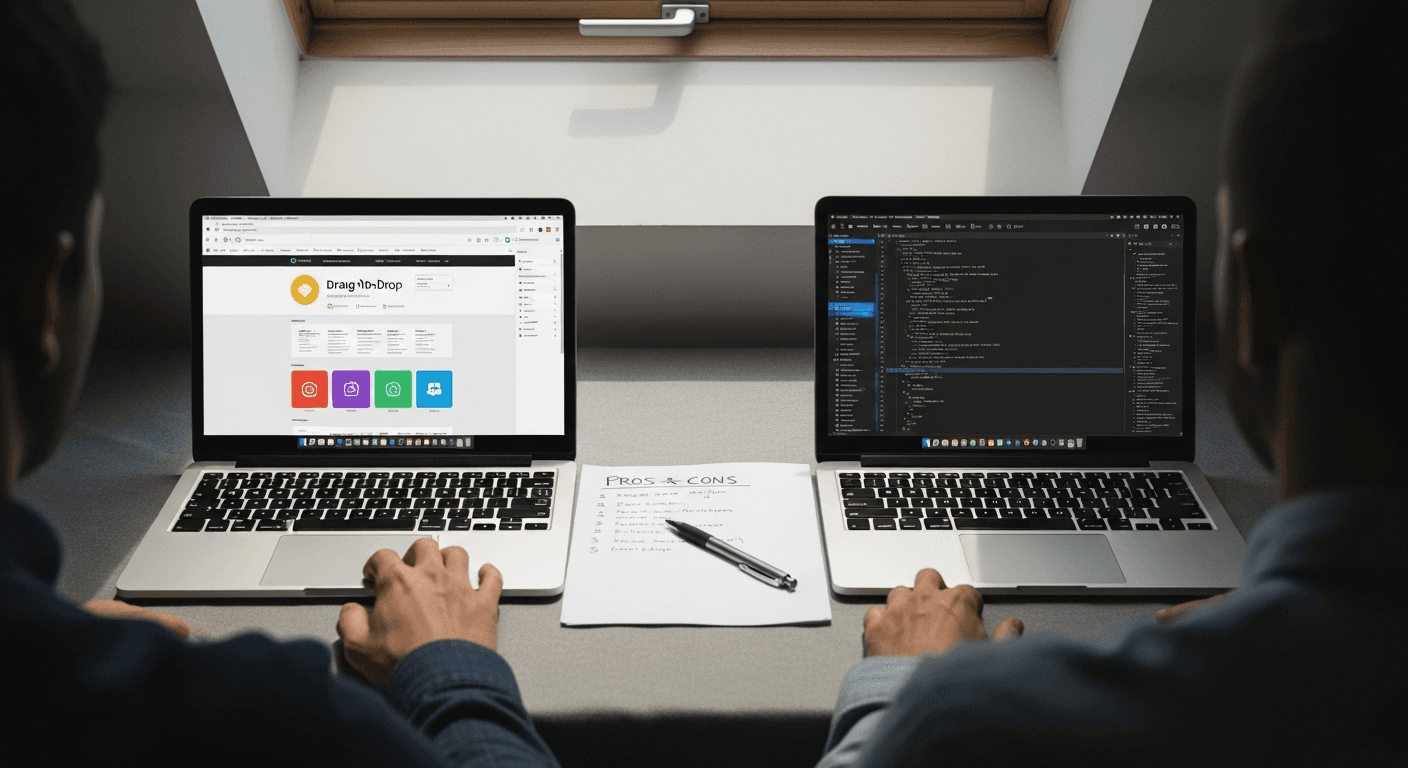
Yes, I'm a developer, so you'd expect me to trash no-code. I won't — I've told founders to use Bubble instead of hiring me. The honest answer to "no-code or custom for my MVP?" depends on one question most articles skip: what kind of risk are you actually testing?
The short version: use no-code to test whether anyone wants the thing. Use custom code the moment the thing IS the product — real business logic, your own data model, performance, or anything you'll build a company on. The expensive mistake is not choosing wrong; it's staying too long.
What no-code genuinely wins at
- Speed to signal: a landing page + form + Airtable can test demand this week, for the price of a dinner.
- Founder autonomy: you iterate without waiting for anyone.
- Internal tools: dashboards and back-office flows that customers never see — no-code is legitimately the right answer there, sometimes permanently.
Where the wall is (and everyone hits it)
Custom business logic that doesn't fit the platform's blocks. Performance as data grows. Integrations the platform doesn't offer. Owning your data and code — you're renting your product from a platform that sets the pricing. And the migration: rebuilding a grown no-code app in real code later costs more than building it in code would have, because now there are users, data, and expectations attached.
The math founders skip
No-code looks like $100/month vs a $10k build. But price the trajectory: if the test succeeds, you'll pay for the rebuild anyway — later, under pressure, with migration pain on top. A custom MVP with a senior developer runs $5k–15k (full cost breakdown here) and is an asset you own, extend, and raise on. No-code money buys a test; custom money buys a foundation.
My honest decision rule
- Unvalidated idea, no budget: no-code, this week. Don't pay me yet.
- Validated demand or paying pilot users: custom, now — before the no-code version accumulates users you'll have to migrate.
- The product is technically simple forever (directory, booking page, form flows): no-code might be the permanent answer, and that's fine.
- The product needs logic, scale, or is your moat: custom from day one. A focused build takes four weeks, not four months.
A hybrid most people don't consider
Custom product core + no-code around it: real code for what customers pay for, Airtable/Zapier/Notion for ops, CRM and internal dashboards. You get ownership where it matters and speed where it doesn't. It's how several of my clients run today.
Not sure which side you're on?
Describe your idea and I'll tell you honestly — including "use Bubble, don't pay me yet," which I've said before. Check what I build, then ask me.
Looking for someone to build it? That's exactly my MVP Development service — scope defined together, fixed price, shipped to production in 4–8 weeks.
Enjoyed this article?
Let's build something together.