

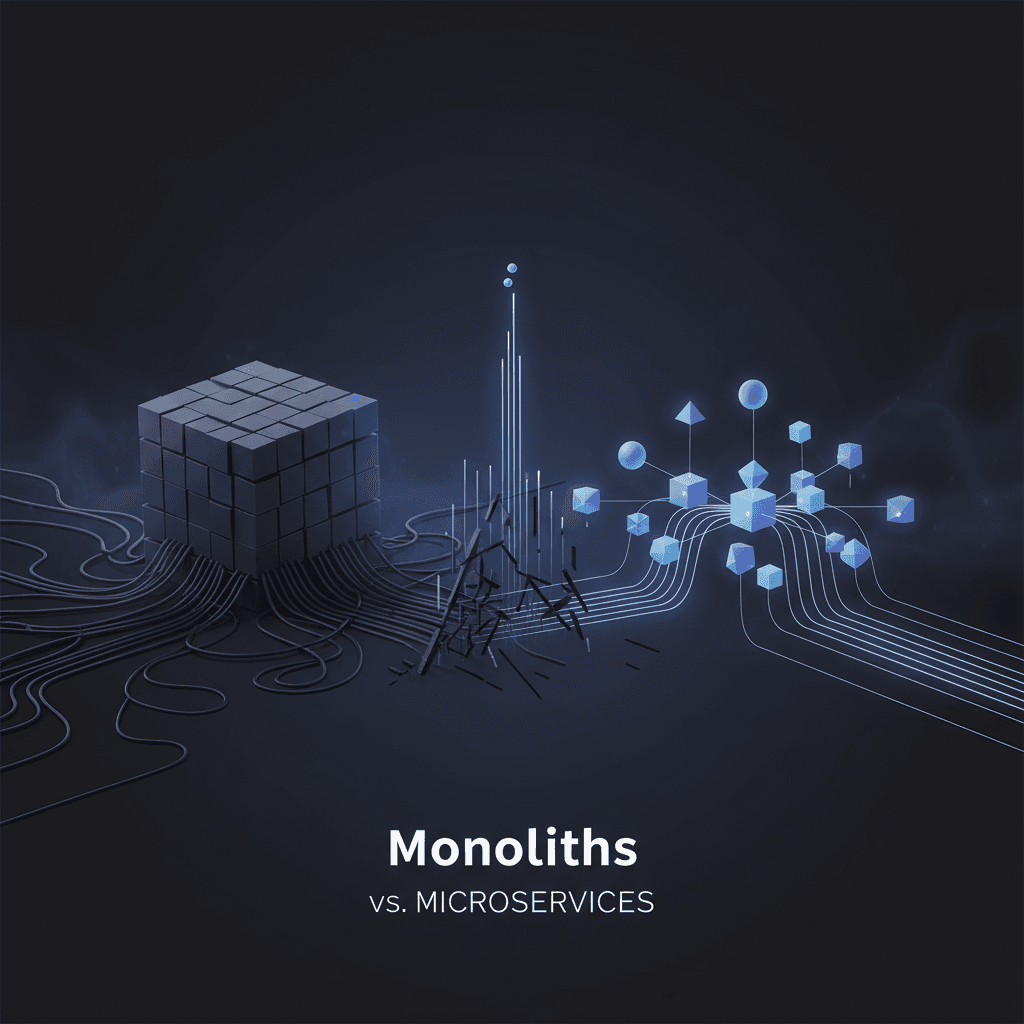
It’s a question that echoes in every software architect’s mind at some point: monolith or microservices? The debate often feels less like a technical decision and more like a philosophical one, especially when you’re starting a new project.
I’ve been there, staring at a blank canvas, wondering which path leads to the least pain down the road. The truth is, there’s no single right answer, and the default advice often overlooks the messy reality of shipping products.
Choosing between monoliths and microservices isn't about right or wrong, but about understanding the trade-offs at each stage of a product's lifecycle and aligning architecture with team needs.
Why Do Monoliths vs. Microservices Keep Coming Up?
This architectural debate persists because both approaches offer compelling advantages and distinct challenges depending on context.
When we talk about monoliths, we typically mean a single, unified codebase where all the components of an application are tightly coupled and run as one service. This can be appealing for its simplicity in initial development and deployment.
Microservices, on the other hand, break an application into a collection of small, independent services, each running in its own process and communicating through lightweight mechanisms. The promise here is often around scalability and team autonomy.
The Underrated Power of a Well-Built Monolith
Starting with a monolith can be surprisingly effective, especially for new products or small teams, due to its inherent simplicity.
With a monolith, development speed in the early stages is often faster because you don't have to worry about distributed transactions, inter-service communication overhead, or complex deployment pipelines. Everything lives in one place, making local development straightforward.
Deployment is also simpler; you're often deploying a single artifact, reducing the operational complexity. For a small team, managing one codebase and one deployment process is a significant advantage, freeing up cycles for feature development.
A common mistake is prematurely optimizing for scale that you don't yet have. A well-designed monolith can handle surprising amounts of traffic before becoming a bottleneck.
Debugging and testing can also be more straightforward within a single codebase, as you don't have network boundaries to cross or multiple services to coordinate. Tracing issues across service boundaries in a distributed system adds a layer of complexity that early-stage projects rarely need.
When Microservices Deliver (and Demand) Their Value
Microservices truly shine when you hit specific points of scale, team growth, or business complexity that a monolith struggles to address.
Independent deployability is a huge win, allowing different teams to release features without coordinating with other teams' deployment schedules. This accelerates delivery and reduces the risk of large, monolithic deployments failing.
Scalability becomes more granular; you can scale only the services that require more resources, rather than the entire application. This can lead to more efficient resource utilization and better performance for high-traffic components.
Technology diversity is another advantage, letting teams pick the best tool for each specific service. While this sounds great, it also introduces complexity, as you might end up supporting multiple languages, frameworks, and databases.
// Example: A simplified microservice API gateway call
async function getUserProfile(userId: string) {
  const user = await fetch(`http://user-service/users/${userId}`);
  const orders = await fetch(`http://order-service/orders?userId=${userId}`);
  return { user: user.json(), orders: orders.json() };
}
This kind of architecture allows you to change the user-service without touching order-service – a huge benefit for focused teams.
Understanding the Hidden Costs Beyond Just Code
The architectural choice impacts more than just lines of code; it reshapes how teams work, how operations function, and the overall cognitive load.
Moving to microservices often introduces significant operational overhead. You're no longer managing one application, but many, each with its own deployment, logging, monitoring, and scaling requirements. This necessitates robust DevOps practices and automation.
Complexity in communication and data consistency is another challenge. Ensuring data integrity across multiple services, handling distributed transactions, and dealing with network latency requires careful design and introduces new failure modes. It's like trading one big problem for several smaller, interconnected problems that all need to be solved.
Team organization is also deeply affected. Microservices work best with autonomous, cross-functional teams, each owning one or more services. If your team structure isn't ready for this, microservices can quickly become a distributed monolith where teams are constantly blocked by each other.
How to Actually Pick the Right Architecture for Your Team
Making the right architectural decision means honestly assessing your current situation, anticipating reasonable future needs, and understanding your team's capabilities.
Start simple: If you're building a new product, start with a modular monolith. Design it with clear boundaries and interfaces, so components could theoretically be extracted later. This gives you the speed of a monolith with an escape hatch for future microservices.
Consider team size and expertise: A small team with limited operational experience will likely be overwhelmed by the complexity of microservices. Focus on building a great product first, not a complex infrastructure.
Identify your scaling bottlenecks: Only consider breaking out microservices when you have clear scaling needs or when different parts of your application require vastly different deployment cycles. Don't split just because it's trendy.
Prioritize business value: Every architectural decision should ultimately serve the business. If a complex architecture doesn't directly contribute to faster feature delivery, better reliability, or improved scalability for your specific needs, it's likely over-engineering.
Ultimately, the choice between monoliths and microservices isn't a static one. It's a journey, and the best architecture is the one that best serves your product and team right now, while allowing for evolution in the future. Don't be afraid to change your mind as your product grows and your understanding deepens.
What's the trickiest architectural pivot you've navigated?
Topics
Enjoyed this article?
Let's build something together.