

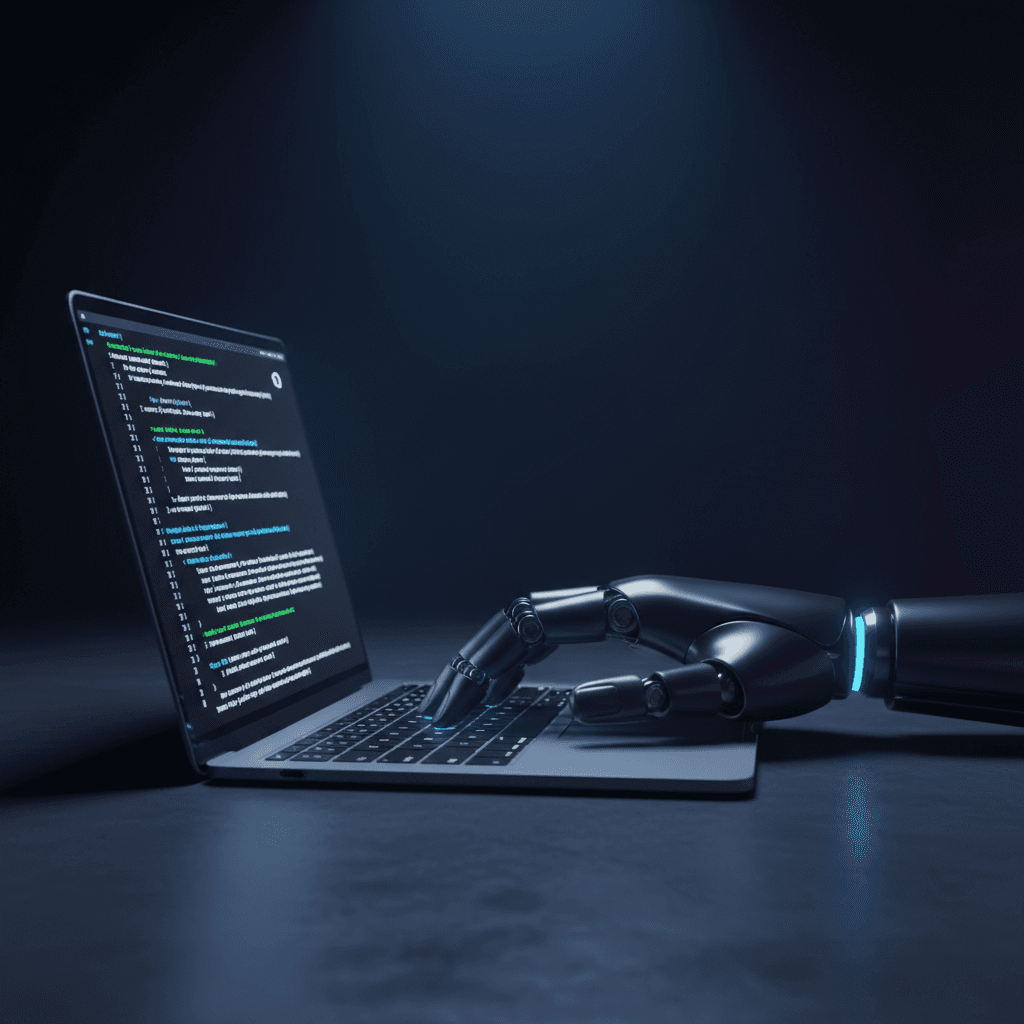
There’s a quiet hum in the background of every developer Slack channel and coffee break these days: the rise of AI. For many, it's exciting, a new tool in the belt. For others, it sparks a genuine fear, a chilling question that whispers, "Is my job next?"
I get it. The pace of change feels relentless, and it’s natural to feel a knot in your stomach when you see AI generating code that used to take hours. This isn't just hype; it's a real shift, and ignoring it won't make it go away.
AI won't replace software engineers outright, but it will fundamentally change the nature of our work, requiring us to adapt our skills and focus on higher-order problem solving.
Is AI going to take my software engineering job?
No, AI is unlikely to replace software engineers entirely, but it will transform the day-to-day tasks and required skill sets for the role. Think of AI as an incredibly powerful assistant, not a replacement for the architect or the project lead.
AI excels at pattern recognition, repetitive tasks, and generating boilerplate code. It can write unit tests, scaffold components, and even suggest database schemas. But it still struggles with nuanced problem-solving, understanding complex business logic, or adapting to truly novel situations.
The real threat isn't being replaced by an AI, but by an engineer who effectively uses AI to amplify their own capabilities. We're moving from being sole code producers to becoming orchestrators of intelligent tools.
What parts of software development will AI change first?
AI will first automate the most predictable and tedious aspects of software development, freeing up human developers for more complex challenges. This isn't a bad thing; it’s an opportunity to shed the repetitive work that often drains our energy.
Consider tasks like generating standard CRUD operations, writing basic API endpoints, or converting data schemas. These are ripe for AI automation. We're already seeing impressive capabilities in:
Boilerplate code generation: AI can quickly spit out the initial structure for functions, components, and even entire microservices.
Test case generation: Crafting comprehensive unit and integration tests, especially for well-defined functions, becomes much faster.
Documentation and refactoring suggestions: AI can analyze code and suggest improvements or generate initial drafts of technical documentation.
I’ve found myself spending less time writing the import statements and more time ensuring the imported components fit the larger system. It's like having a junior dev who never sleeps, but also needs constant supervision to make sure they're not just making things up.
How can developers adapt to AI-powered workflows?
To thrive in an AI-augmented future, developers must cultivate skills in prompt engineering, critical evaluation, and high-level system design. Simply put, learning to communicate effectively with AI tools is becoming a core competency.
This means shifting our focus. Instead of just knowing how to write code, we need to know what code to ask for and why. Key adaptation strategies include:
Mastering AI prompting: Learning to craft precise and effective prompts to get the best output from AI assistants.
Critical review and debugging: AI-generated code isn't always perfect. The ability to quickly identify errors, security vulnerabilities, or inefficiencies in AI output is crucial.
Understanding architectural patterns: As AI handles more low-level coding, our value shifts to designing robust, scalable, and maintainable systems.
Focusing on soft skills: Communication, collaboration, and problem-solving with humans remain paramount.
My journey has been about becoming a better editor and director, rather than just a writer. I still write, of course, but now I have an entire, very fast, but sometimes confused, writing team at my disposal.
The human advantage: Where AI still falls short
Even with advanced AI, human developers retain a critical advantage in creativity, nuanced problem-solving, empathy, and strategic thinking. These are the areas where AI currently struggles and where our value will only grow.
AI can't truly understand the "why" behind a product feature, the emotional needs of an end-user, or the subtle political dynamics within a development team. These require human insight and intuition. Consider these uniquely human strengths:
Product vision and user experience: Designing intuitive interfaces and understanding complex user journeys goes beyond data patterns.
Complex architectural decisions: Balancing technical debt, future scalability, and immediate business needs requires human judgment.
Debugging subtle, distributed system failures: Unraveling issues that span multiple services and involve intricate timing often requires a human's pattern-matching and intuition.
Innovation and true novelty: AI can generate variations, but inventing entirely new paradigms or solutions still requires a spark of human creativity.
This is where our background in design clarity and engineering quality truly shines. AI can give you a block of code, but it doesn't inherently understand if that code delivers a delightful or frustrating user experience.
Beyond coding: New opportunities for AI-savvy engineers
AI isn't just changing existing roles; it's creating entirely new specializations and opportunities for developers willing to explore them. The landscape is expanding, not shrinking.
As AI tools become more integrated into our workflows, the demand for engineers who can build, customize, and manage these tools will skyrocket. This includes roles focused on:
AI tool development: Building the next generation of AI assistants and platforms for developers.
AI ethics and governance: Ensuring AI systems are fair, unbiased, and secure.
Integrating AI into existing systems: Designing APIs and pipelines to connect AI models with traditional applications.
Prompt engineering specialists: Deep experts in crafting effective instructions for complex AI tasks.
This shift means our career paths might diverge in fascinating new directions. It's less about fearing obsolescence and more about embracing a dynamic evolution of what it means to be a software engineer.
This isn't a future to be feared, but one to actively shape. The skills that will matter most are adaptability, critical thinking, and the ability to work with these powerful new tools. The challenges are real, but so are the opportunities for those willing to learn and grow.
Topics
Enjoyed this article?
Let's build something together.